AeroZero®
Flame & Thermal Barriers
Ultra-Thin, Lightweight AeroZero Flame & Thermal Barriers (AZ-FTBs)
What are Flame and Thermal Barriers?
Flame and thermal barriers (FTBs) are a critical safety layer for high-performance systems where temperature and flame control are essential.
They serve two primary functions:
Thermal Management – Isolating and protecting energy-dense components to maintain safe operating temperatures and prevent heat propagation.
Flame Protection – Shielding structural assemblies from chemical, mechanical, and thermal degradation during direct flame or high-temperature events.
Conventional FTBs primarily mitigate combustion but often exhibit high thermal diffusivity, allowing heat transfer that can compromise structural or electrical performance.
Why FTBs Matter
(and how AZ-FTB Changes the equation)
The Challenge:
Conventional flame and thermal barriers (FTBs) — such as mica, ceramic fiber, and silica blankets — protect against combustion, but they come with major trade-offs:
Heavy, bulky, rigid & fragile: Difficult to form around complex geometries
Thermally inefficient: High thermal diffusivity allows heat to penetrate and compromise underlying components.
The Need
Modern aerospace, electrification, and robotics platforms demand flame protection without added mass — barriers that prevent ignition and heat transfer in ultra-thin, flexible formats.
Graph depicts when a 1mm carbon fiber composite is exposed to an 1100 °C flame, the FTB product maintains a temperature differential of approximately 900 °C between the flame-facing surface and the composite, indicating minimal conductive and radiative heat transfer across the barrier.
The AZ-FTB Advantage
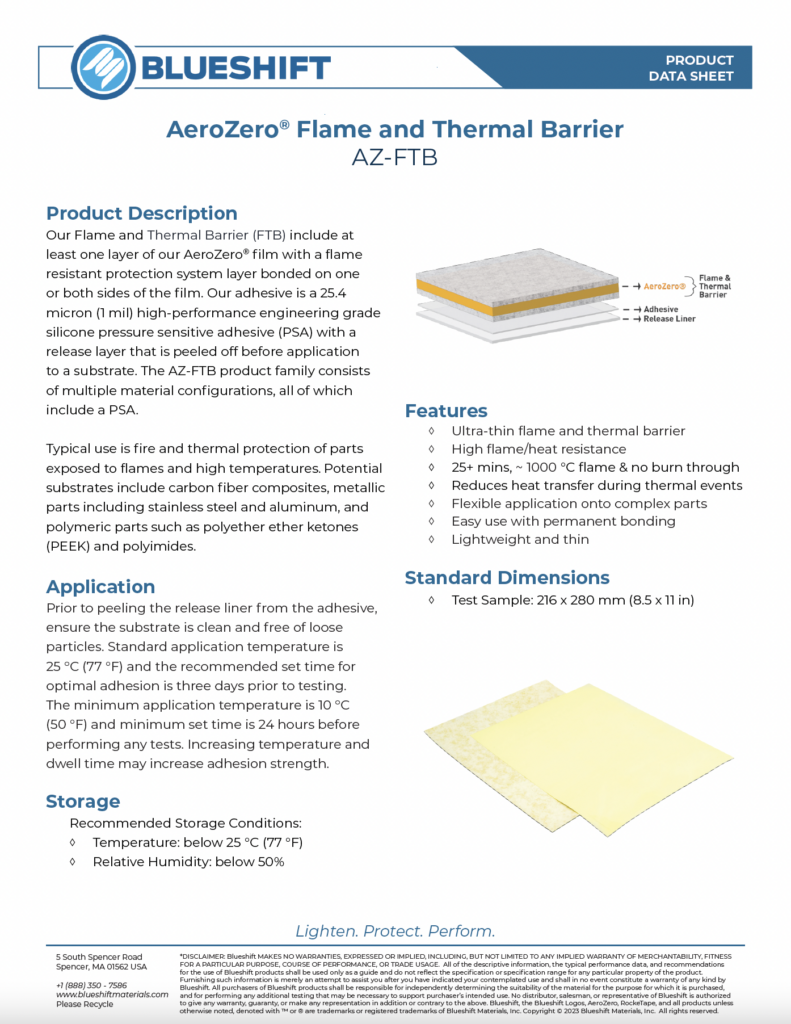
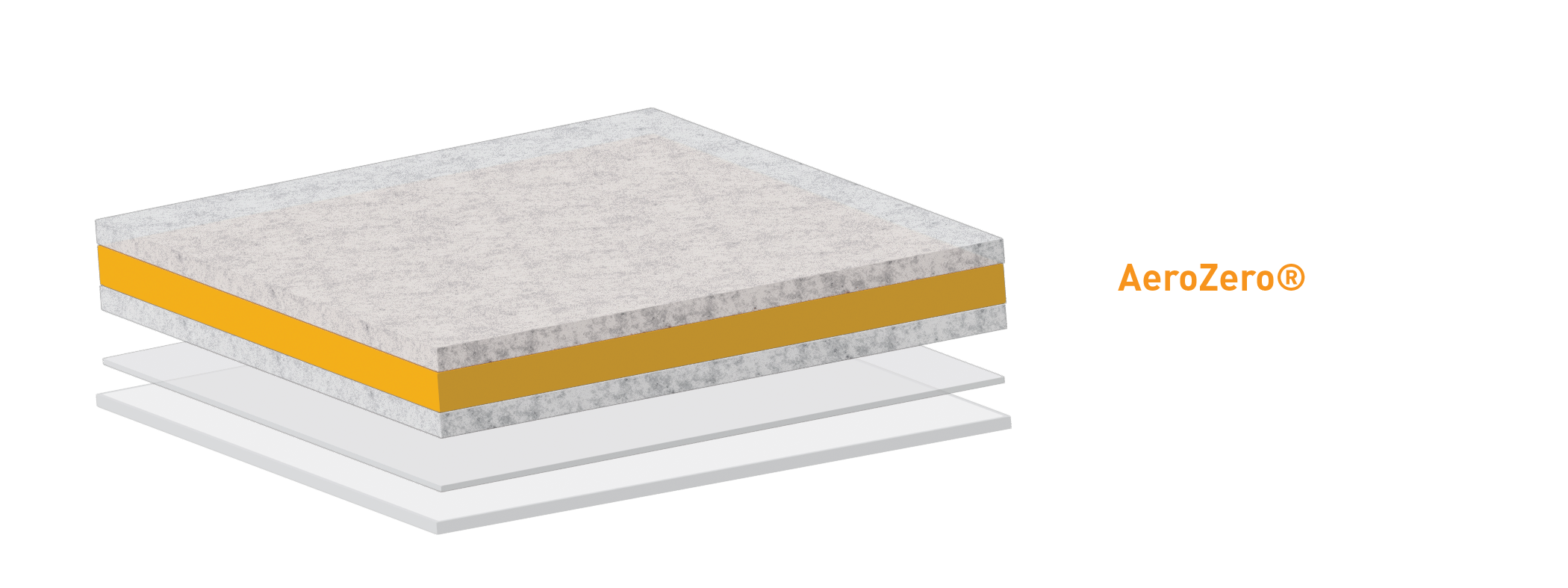
AZ-FTBs combine flame-resistant laminates with Blueshift’s proprietary AeroZero film, characterized by exceptionally low thermal diffusivity and conductivity.
Providing both flame protection and minimizing heat flow, AZ-FTB products preserve the structural integrity and functional performance of protected components even under sustained exposure to temperatures exceeding 1,000 °C.
This synergistic architecture enables performance far beyond conventional FTBs—minimizing heat transfer, maintaining cold-side temperatures, and allowing integration into weight-sensitive platforms.
Excellent Bend Radius:
- Left: AZ-FTB 100, radius 1/16 in
- Middle: AZ-FTB 101, radius 1/6 in
- Right: AZ-FTB 300 radius, 3/4 in
Applications
Defense
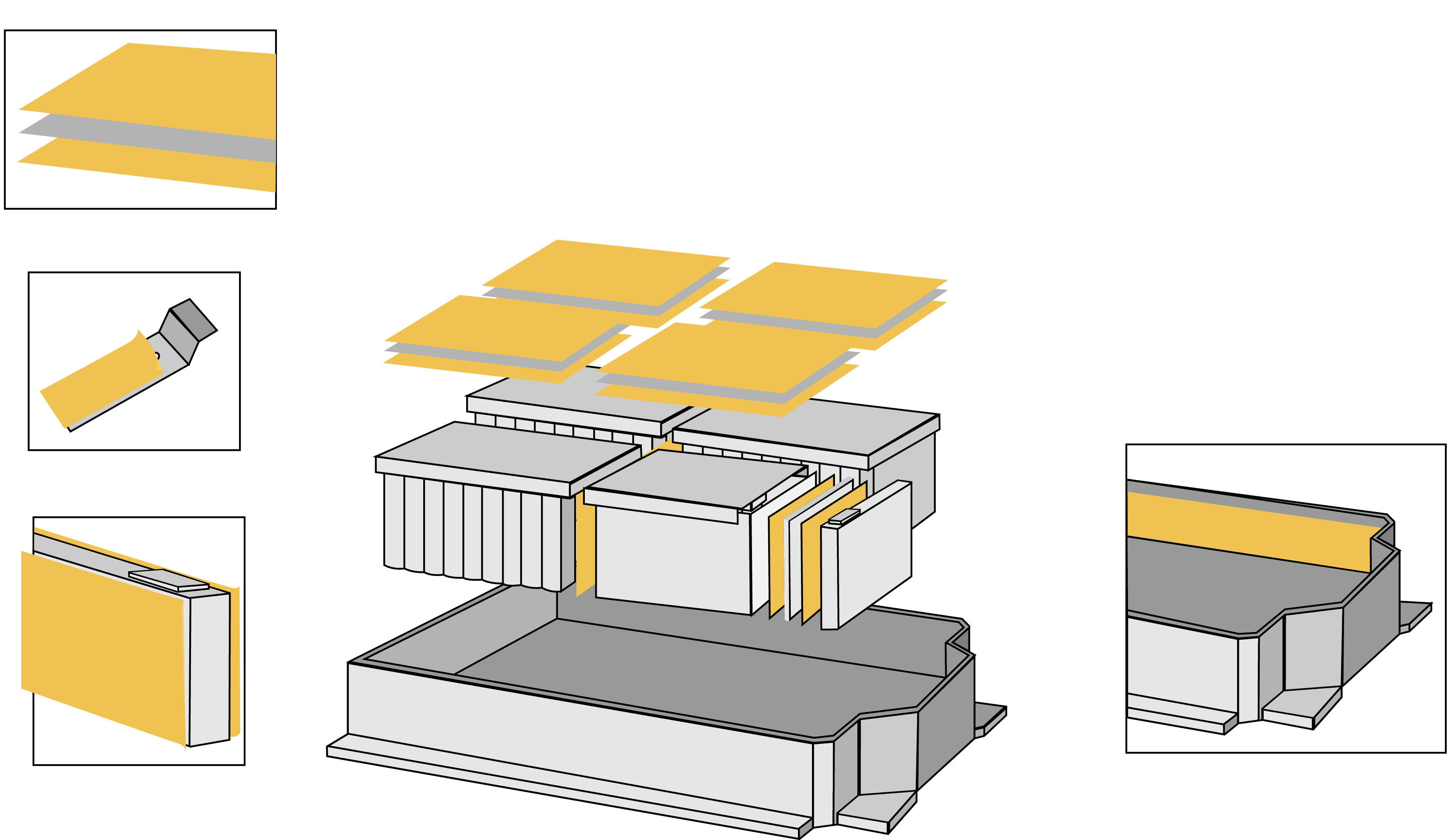
Portable energy packs, wearable power modules, handheld man-portable electronics, ruggedized battery enclosures
Why? Durability, safety
Electronics
Compact battery enclosures, cable harnesses
Why? Thinness, easy integration
Aerospace
Battery modules, composite panels, engine areas, cable harnesses
Why? Weight sensitive, flame and thermal containment, mitigate the risk of thermal runaway
Energy Storage Systems (ESS)
Cabinet and rack isolation, thermal management
Why? Fire safety, dielectric stability
Product Offerings
AZ-FTB 100
- Application Example: Indirect flame, direct heat for compact electronics
- Exposure Temps and Time: < 500 ºC for 15-30 minutes
AZ-FTB 101
- Application Example: Indirect flame, direct heat in pack walls, electronics
- Exposure Temps and Time: 500 – 800 ºC for 15 – 30 minutes
AZ-FTB 300
- Application Example: Thermal runaway and direct flame protection in battery housings
- Exposure Temps and Time: 1,000 – 1,200 ºC for 15 – 30 minutes
Contact us
Ready to give your new go-to solution a try?
Partner with Blueshift to engineer safety and performance into your next-generation systems.